Light on Panel: How to Identify Failures
Anúncios
A light on your car dashboard is always a sign that something needs attention.You can now identify exactly what is happening using just your phone, without having to go straight to the workshop.
Modern technology allows you to read error codes and understand what each indicator means, saving you time and money.In this article, we will explore current best practices and trends for interpreting these warning signs in your vehicle.
Why Do Panel Lights Light?
Every light that appears on the dashboard of your car is an intelligent warning system.When sensors detect irregularities in the operation of the engine, electrical system or other components, these lights come on to warn you about possible problems.The important thing is not to ignore these signals, as they can prevent further damage in the future.
The fault codes generated by the vehicle’s embedded systems are standardized and can be decoded. In the past, you would need to take the car to a specialized workshop with expensive equipment to obtain this information. Today, with a mobile application and a compatible Bluetooth scanner, you can access this data in minutes.
Tools Needed for Cell Diagnosis
The first thing you need to diagnose failures by mobile phone is a Bluetooth OBD-II scanner.There are several brands available in the market, such as Bluetooth OBD generic scanners or models from recognized manufacturers. These devices connect to the OBD-II port of your car, usually located under the dashboard, near the steering wheel, or below the console.
 ELM OBD2 Car Scanner
Classification:
”’ think it’S.
4.81
Age Classification:
Free Classification
Author:
CAR SCANNER LLC
Platform:
Android
Price:
Free
▶Download on Google Play
ELM OBD2 Car Scanner
Classification:
”’ think it’S.
4.81
Age Classification:
Free Classification
Author:
CAR SCANNER LLC
Platform:
Android
Price:
Free
▶Download on Google Play
In addition to the physical scanner, you will also need to install an application on your mobile that is compatible with your chosen device. Apps such as Torque, DashCommand and Carista are examples of popular tools that decode error codes and present information in clear language.Many of these applications offer free versions with basic functionality and paid versions with advanced features.
How to Connect Scanner to Your Phone
After purchasing your OBD-II scanner, the connection process is quite simple. First, you turn on the scanner on the OBD-II connector of your vehicle, which is the first step to establish communication with the car’s electronic system. Then you activate the Bluetooth of your mobile phone and search for new devices, finding the scanner in the list of available devices.
The connection usually requires a default password, which in most cases is “1234” or “0000”. Once connected, you open the chosen application and authorize it to access the Bluetooth from your mobile phone. The application will then begin to communicate with the car system, reading all the available data in real time.
Interpreting Lights and Error Codes
Each light on the panel has a specific meaning and corresponds to an error code in the system. The engine red light, known as Check Engine Light, is one of the most common and indicates that the emission control system has detected a problem. This light can mean from a faulty oxygen sensor to more serious problems with the catalyst.
When you connect the app to the scanner, it displays P codes (failure codes), which start with the letter P followed by four numbers. The first digit after P indicates the category (ex: P0 means fuel and air systems), making it easy to quickly identify the affected component. Knowing these codes allows you to make informed decisions about urgent repairs or preventive maintenance.
The yellow oil pressure light, for example, signals that the oil pressure has dropped below normal, which can indicate from lack of oil to problems in the pressure sensor. Blue light, when present in some vehicles, alerts you about problems with the airbag, and you should definitely not ignore it under any circumstances.
Current Trends in Automotive Diagnostics
The current trend is the ever-increasing integration of Artificial Intelligence into diagnostic applications.Many platforms now offer predictive analytics that alert you to problems before the light even lights up on the dashboard, based on vehicle behavior patterns.This means you can be more proactive in maintenance, avoiding bigger problems.
Another relevant trend is the standardization of data between manufacturers. Although each car brand has its particularities, the OBD-II protocol ensures that universal tools work on almost any vehicle manufactured after 1996. This universality simplifies diagnosis and democratizes access to technical information.
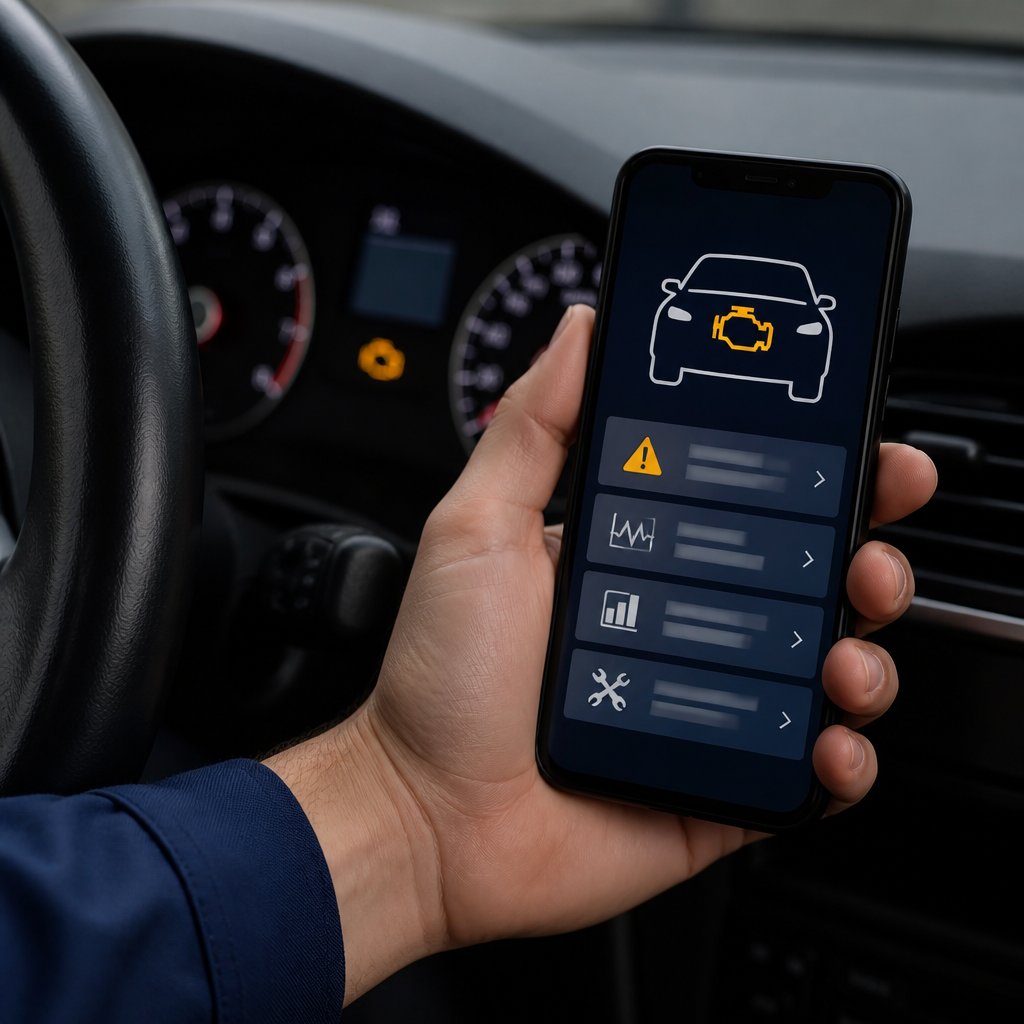
Many automotive manufacturers have also started offering their own connected apps, allowing direct diagnostics via smartphone. These proprietary solutions offer greater accuracy for specific models and sometimes include remote maintenance or automatic scheduling of revisions.
Best Practices for Using OBD-II Scanner
The first best practice is to connect the scanner regularly, even when no light is on. This allows you to establish a normal database of your vehicle and detect subtle anomalies before they become serious problems. Many owners who follow this routine manage to extend the life of their cars significantly.
When dealing with error codes, it is important to differentiate between critical problems and problems that can wait. A failure in the inlet air temperature sensor is less urgent than an oxygen sensor failure, which directly affects fuel economy and emissions. Using the detailed description provided by the application helps you prioritize the necessary actions.
Take screenshots of the error codes and data readings. This information is valuable when you take the car to a workshop, as it provides a complete history of the problem to the mechanic.This also prevents you from being charged for unnecessary diagnosis, since the initial technical work has already been carried out.
Always turn off the engine before connecting or disconnecting the OBD-II scanner. Although the device is designed to be safe, this simple practice protects both the equipment and the electronics in your vehicle from potential problems caused by voltage variations.
| Panel Light | Color | Meaning | Urgency |
|---|---|---|---|
| Check Engine | Yellow/Red | Failure of the emissions system or engine | Average to High |
| Oil Pressure | Red | Oil pressure below normal | High |
| Engine Temperature | Red | Superheated engine | High |
| Battery | Red | Load system problem | Average |
| ABS (Breets) | Yellowish | Failure of anti-lock brake system | Average |
| Airbag | Red | Problem with the airbag system | High |
| Low Fuel | Yellowish | Critical fuel level | Low |
| Wick Tire | Yellowish | Inadequate pressure on one or more tires | Average |
Limitations and When to Seek a Professional
Although the OBD-II scanner is a powerful tool, it is important to understand its limitations.The device reads only the codes generated by the car’s electronic system, which means that pure mechanical problems, such as worn bearings or structural problems, may not be detected. A strange sound in the engine, excessive vibration or anomalous behavior of the car should still be investigated by a qualified professional.
In addition, not all error codes are the same. Some indicate an intermittent fault or a sensor with incorrect reading, while others warn of genuine damage that requires immediate repair.The knowledge provided by the scanner should complement, not replace, the evaluation of an experienced mechanic in complex cases.
If you have no previous experience with automotive mechanics and the code seems related to safety-critical systems such as brakes, power steering or airbags, do not hesitate to look for professionals. These systems are essential for your safety and that of other people on the road, justifying consultation with experts.
Protecting Your Investment with Proactive Monitoring
Using the scanner regularly is part of a broader preventive maintenance strategy.You can create a monthly or quarterly check schedule to monitor the overall performance of your vehicle, noting any changes in data readings. This proactive approach often detects problems in early stages, when repair is simpler and cheaper.
Many older car owners find that regular monitoring through the OBD-II scanner significantly extends the life of the vehicle. Small adjustments made early, such as cleaning sensors or changing spark plugs at the right time, prevent problems from accumulating and result in catastrophic failures.
Conclusion
A light on your car dashboard no longer needs to be a mystery that requires an urgent trip to the workshop.With a Bluetooth OBD-II scanner and a compatible app on your mobile, you have access to technical information that was once unique to professionals. This democratization of automotive information allows you to make more informed decisions about maintenance and repairs of your vehicle.
Current trends point to an even greater integration of technology in automotive diagnostics, with Artificial Intelligence and predictive analytics transforming the way we care for our cars. By following the best practices of proactive monitoring and understanding the limitations of this tool, you can extend the life of your vehicle, save on unnecessary repairs and ensure your safety on the road. Knowledge is power, and now you have the power to understand what your car is trying to say.