
TV in the Palm of the Hand: Watch Anywhere
Anúncios
Watching television has completely changed.You no longer need to be at home, tied to a fixed device in the room, to keep up with your favorite programs, series, movies and championships.Today, technology puts quality entertainment in the palm of your hand, allowing you to watch any content, anywhere and anytime.
This practical guide shows you exactly how you can turn your smartphone, tablet or any mobile device into a complete television experience, without giving up quality, ease or convenience.Let’s walk together through the real steps, best practices and solutions that really work for those who want total freedom when it comes to having fun.
Why TV in the Palm of the Hand Became Reality
For years, watching a television program was a stationary activity.You chose a time, felt on the couch and hoped not to miss anything. If you left home, you missed the chapter. If you arrived late, your problem. This reality has changed thanks to three main factors: the evolution of the mobile internet, the emergence of streaming platforms and the improvement of portable devices.
The 4G internet and now 5G has made it possible to transmit high-quality video directly to your mobile phone. At the same time, companies have created services specialized in transmitting content on demand, without relying on fixed schedules. Smartphones have evolved into cameras, processors and screens, turning these devices into real entertainment centers. You now have a portable device with more processing power than computers ten years ago, capable of displaying content in 4K resolution.
This combination of factors has created an unprecedented scenario: you can carry an entire library of movies, series and programs in your pocket. There are no cables, no complicated installations, no need to be in a specific place. Just internet, an application and the will to entertain.
 PopCue
Classification:
^^^^^^^^^^^^^^^^^^^^^^^”’
4.29
Age Classification:
Free Classification
Author:
Mobi Connect Trek
Platform:
Android
Price:
Free
▶Download on Google Play
PopCue
Classification:
^^^^^^^^^^^^^^^^^^^^^^^”’
4.29
Age Classification:
Free Classification
Author:
Mobi Connect Trek
Platform:
Android
Price:
Free
▶Download on Google Play
The Apps That Transformed Access to Content
There are dozens of different platforms offering television and movie content for your mobile device. Each of them works in a similar way, but with important differences in catalog, price and broadcast quality.For you to better understand how to choose, we will detail the main options available in the market.
The first major streaming service has completely changed the industry. It offers from classics to unique original productions, with content in several languages and for all ages. You can create different profiles for each family member, receive personalized recommendations and of course watch on any mobile device. The application detects your internet connection automatically and adjusts the video quality to ensure that you do not suffer from crashes.
Other platforms focus on specific genres.Some specialize in series, others in action films, others in high-quality documentaries.There are still those that offer live content, broadcasting programming from traditional television channels directly to your mobile phone, just as you would watch on home TV. This variety means that you can choose just what you want, paying only for what you will use.
Many of these apps allow you to download content to watch later, without needing internet at that time. This is an extremely practical feature: you download an entire series on WiFi at home, and when you go out to travel by bus or plane, you can watch the full episode without spending mobile data.
The Practical Step-by-Step To Get Started Today
If you’ve never used a streaming service before, the word “complicated” may come to mind. Actually, the process is extremely simple, and you can be watching in less than five minutes.
First, choose the device you will use. Your smartphone is the most practical option, as it is always with you. A tablet offers a larger and more comfortable screen for longer sessions. A smartwatch may even work, but it is definitely not ideal. Assuming you chose the smartphone, open the app store of your device, be it the Google Play Store (Android) or the Apple App Store (iOS).
In the store, search by the name of the streaming application you have chosen. You will see the application page with description, reviews of other users and file size. Click on “Install” or “Get” and wait for the download and installation to finish. This process usually takes a few minutes depending on your internet speed and the size of the application.
When the installation is over, open the app for the first time. You will see a welcome screen inviting you to create an account. Click on “Register” or “Create Account” and follow the instructions.You will usually need to provide a valid email address, create a password and confirm your address. Some platforms ask for additional information such as date of birth or payment method at this time, while others leave this for later.
After creating your account and logging in, you will get to the home screen of the application. Here you will see content recommendations, featured programs and sections organized by gender.If the platform offers free content, you can start watching immediately.If you require a paid subscription, you will have to confirm the payment data before accessing the full catalog, although many platforms offer a free trial period.
Now comes the fun part: look for a movie or series you want to watch. Use the search bar at the top of the screen or browse through the categories. When you find something interesting, click or tap to open the content page. There you will see synopsis, cast, duration and in many cases a trailer to watch before committing to the complete work.
Click the play button and the video will start streaming immediately. If your internet is fast enough, the quality will be automatic and the video will start in seconds. If your connection is slower, the app may take a few seconds to load, displaying a loading screen while preparing the video. You can pause, fast forward, rewind and even disable the subtitles using the on-screen controls.
Image Quality: From Understanding to Practice
A common concern when watching television by mobile phone is the quality of the image. After all, you are used to a large television screen, then a smartphone may look inferior.In reality, modern smartphones offer impressive resolutions, and in many cases, the quality you watch is superior to what a traditional television can display.
Most streaming apps offer multiple streaming quality options. The most common is Full HD, also called 1080p, which is exactly the same resolution you see on a traditional television.Some apps offer up to 4K, which is four times more detailed than Full HD. The downside is that the higher the quality, the more internet data you consume. One hour of Full HD video can use one gigabyte of data, while 4K uses three or four times more.
To get the most out of quality, you need a fast and stable internet connection. WiFi at home is ideal as it offers high speeds and unlimited data. When you are out using mobile data, consider reducing the quality to save your monthly deductible.Most apps allow you to set this up in the quality settings by choosing between “Low”, “Medium”, “High” or “Very High”.
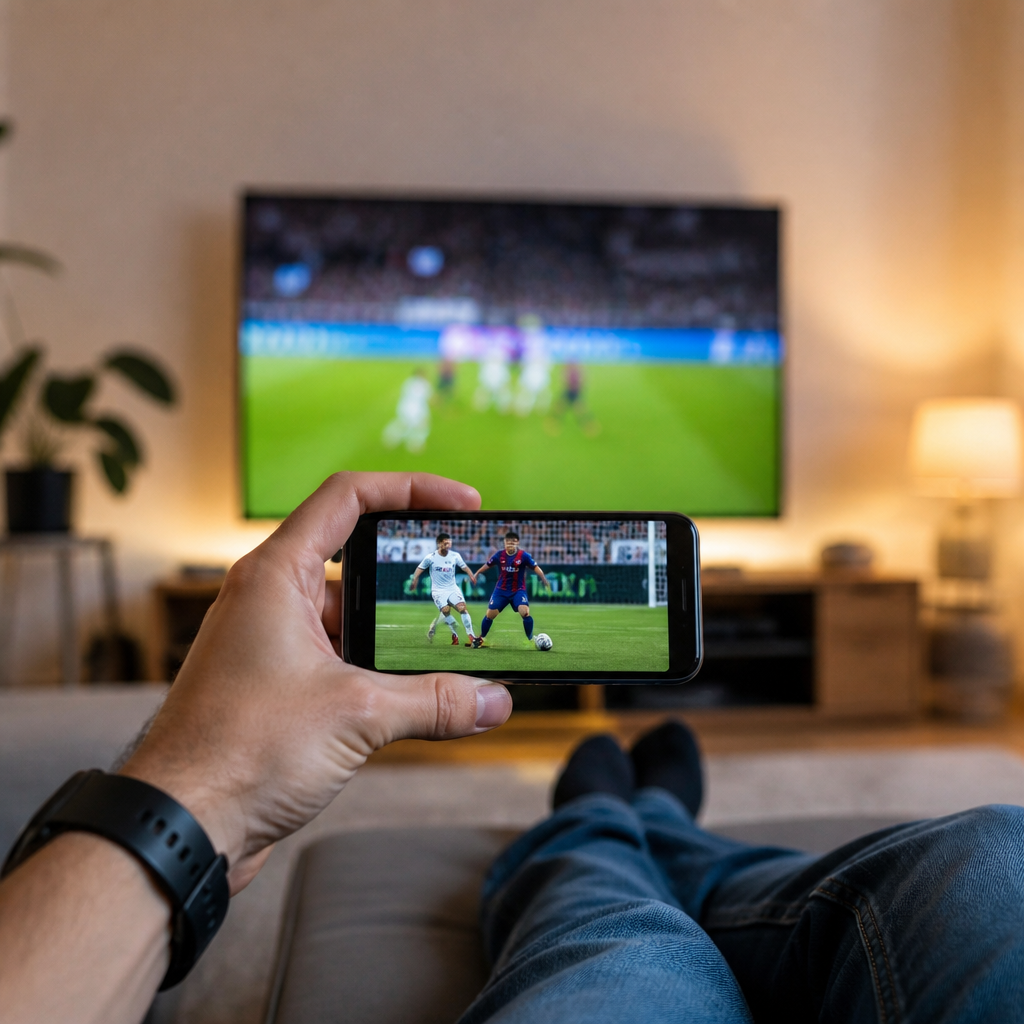
A smartphone with AMOLED display, common in high-end devices, offers more vibrant colors and purer blacks than an LCD screen. But even a more basic smartphone offers a pleasant visual experience, especially since the distance between your eyes and the screen is shorter than on a television, making it possible to see more detail at lower resolutions.
Connecting Your Phone to Television For Extended Experience
If you want the best of both worlds, there are ways to connect your mobile device directly to your television. This offers the convenience of having the palm control and the big screen of the TV to view the content.
The simplest option is to use an HDMI cable with adapter specific to your device. A common HDMI cable comes out of your television and a tip connects to the smartphone via Lightning adapter (for iPhones) or USB-C (for many Android). You connect the cable and the image of your mobile appears on the TV almost instantly. The disadvantage is that you get stuck to the length of the cable, but it is the most reliable way and offers the best transmission quality.
Wireless technology solves the problem of cable.You can use Chromecast, which is a small device that you connect to your television and your WiFi network. Once set up, any streaming application detects Chromecast and offers a button to “broadcast” the content to the TV. You control everything by smartphone: pause, volume, fast forward.It is extremely convenient. AirPlay works in a similar way if you use iPhone and an Apple TV.
Some modern televisions already have these technologies integrated. If your TV is relatively recent, it probably has WiFi and native support for wireless transmission. In these cases, you do not need any additional accessories, just connect the phone to the same WiFi network as the TV and use the broadcast button inside the application.
Optimizing Your Internet Connection For Streaming Without Locks
The quality of your palm TV experience directly depends on the speed and stability of your internet. A video crashing every ten seconds makes the experience frustrating, and you will lose interest quickly. Fortunately, there are several practical strategies to ensure that your connection is optimized for streaming.
First, understand your current speeds.There are free apps and websites that measure your internet speed in megabits per second (Mbps). For Full HD streaming, you need at least 5 Mbps of consistent speed.For 4K, it is recommended 25 Mbps or more. If your speed is below that, you will have problems. But before calling your internet provider, try other things that can solve the problem.
The first strategy is to position yourself closer to your WiFi router. WiFi signals weaken with distance and can be blocked by walls. If you are in the back room of the house and the router is in front, the signal quality drops dramatically. Approaching the router often resolves crashes and slow buffering. If this is not practical, consider repositioning the router to a more central location in your home.
Second, disable other devices connected to your network. If you have five people at home, each with a smartphone, tablet and smart TV, your broadband is divided between all these devices. Disabling WiFi on devices you are not using frees up bandwidth for your streaming smartphone. Close also navigation tabs on your mobile that may be using internet in the background.
Third, try to reduce the broadcast quality temporarily to see if this solves the problem. If you are watching in 4K and there are constant crashes, reduce to Full HD. Usually, this solves the problem immediately. Once solved, you can go back to increasing the quality when your connection improves or when using WiFi faster.
Fourth, restart your router. Disconnect from the power outlet, wait thirty seconds and reconnect. This forces the router to restart completely and often resolves intermittent connection issues. Also restart your smartphone if crashes persist, as sometimes the operating system needs to reset network connections.
Security and Best Practices to Protect Your Account and Data
As you spend more time watching content on your mobile device, your personal security becomes increasingly important.Your streaming accounts contain payment information, personal viewing history, and access to content you subscribe to. Protecting this is essential, and fortunately, not complicated.
The first and most important practice is to use a strong and unique password for each streaming account. A strong password contains at least twelve characters, mixing uppercase and lowercase letters, numbers and symbols. Avoid using your name, date of birth or anything that someone you know can guess. Do not use the same password you use in your email account or bank, as this would mean that if a streaming platform is hacked, all your accounts would be compromised.
Use two-factor authentication if the streaming platform offers. This adds an extra layer of security: even if someone discovers your password, they will not be able to sign in to your account without the code you receive via text message or authenticator app.
Beware of public WiFi connections.When you are in a cafe or airport and connect to free WiFi, everyone on the same network can potentially see your internet traffic if it is not encrypted.For maximum security, avoid logging into important accounts while using public WiFi.If you need to do so, use a VPN, which encrypts your entire connection.There are free VPN apps available in the app store, although paid versions offer more speed and reliability.
Regularly check the activity on your streaming account.Many platforms allow you to see all the devices currently connected to your account. If you see a device that does not recognize, disconnect it immediately. This means that someone has gained access to your account and is watching content on your payment. Change your password immediately if this happens.
Finally, keep your mobile device secure. Use a biometric access or recognition code (fingerprint or facial recognition) to unlock your phone. Install security updates as they become available. These simple steps protect not only your streaming account, but all of your personal information stored on the device.
The transformation of how we watch television is one of the clearest examples of how technology changes our everyday lives. You are no longer stuck on a couch, a time slot or a location.The freedom to choose when, where and what to watch is literally in the palm of your hand. From installing the app to optimizing your internet connection, every step you take brings you closer to a truly limitless entertainment experience.


