IA Recreates Your Face with 80s Style
Anúncios
Artificial intelligence has transformed the way we experience our own image, allowing you to recreate your face with completely different styles and eras.Today, advanced technologies are able to analyze facial features, adjust proportions and apply visual trends from any historical period.If you have never explored this possibility, get ready to discover how AI can transport your appearance to the 80s, complete with accuracy.If you have never explored this possibility, get ready to discover how AI can transport your appearance to the 80s, complete with nothing and genuine hair.
Many people believe that transforming their image in this way is complex or requires advanced skills in photo editing.However, the reality is quite different: anyone with a smartphone or computer can access AI tools that do this job practically alone.
How AI Analyzes and Reconstructs Facial Characteristics
Artificial intelligence uses deep neural networks to map every detail of your face with millimeter precision.When you send a photo, the system identifies key points such as eyes, nose, mouth, chin and jaw line, creating an invisible three-dimensional “face mesh”.
After identifying these characteristics, AI appliances trained machine learning algorithms with thousands of images from the 80s. These algorithms studied how people actually dressed, combed and made up at that time, capturing not only superficial trends but genuine proportions, colors and styles.
One of the most complex processes is the three-dimensional reconstruction of the face. AI does not work only with flat images; it creates a 3D model based on how light interactions with your skin, where shadows fall and how the angles of your face behave. In this way, when you apply the style of the 80s, you can maintain naturalness even by adding voluminous hair, loose clothing and accessories characteristic of that era.
 Vintage photo maker
Classification:
^^^^^^^^^^^^^^^^^^^^^^^”’
4.42
Age Classification:
Classification 12 years
Author:
CRE APP.COM
Platform:
Android
Price:
Free
▶Download on Google Play
Vintage photo maker
Classification:
^^^^^^^^^^^^^^^^^^^^^^^”’
4.42
Age Classification:
Classification 12 years
Author:
CRE APP.COM
Platform:
Android
Price:
Free
▶Download on Google Play
The Most Common Mistakes in Using AI Tools for Transformation
The first mix you are like to make is sending photos of poor quality or with inadequate lighting.When the AI receives a blurry image, with too sharp or too light shadows, it has difficult correct mapping facial features.Result: a transformed face with strange proportions, broken symmetry or unrealistic textures. Always shoot in a well-lit place, preferably with natural light, and make sure that your face is clearly visible.
Another common mix is to use photos with very sharp angles or unusual poses.If you shoot your face from the side, with your head tilt or at a very up or down angle, the AI will have difficult recognizing consistent facial patterns.This causes distortions that are practically impossible to correct afterwards.For results, take a front photo with your face straight, looking directly at the camera, with a neutral and best expression.
Many people make the mix of not clearly specifying which aspect of the 80s they want to recreate.This decade was so varied that it covers from the punk and new wave style of the beginning to the excessive glamor of the mid-80s. If you do not define the specific style you want, AI can generate something generic that does not capture the essence you imagined. Research specific styles, use of the image, and use of the image 80.
Another frequent misconception is to ignore the complementary adjustments after the AI generates the image. You should not consider the result as final and immutable. Sometimes the hair gets a little too bulky, the colors of the clothes need to be adjusted or the accessories of the not match well. Simple editing tools can refine these details, significantly improving the final result without compromising the quality that the AI has already created.
Choosing Ideal Base Photographs
The quality of the initial image is absolutely critical for a satisfactory result with AI. You should look for photos where your face occupies at least 50% of the frame, ensuring that there is enough information for the system to work. Images too far away where you appear too small will result in transformations with less detail and facial accuracy.
Lighting is critical and often overlooked. Avoid photos taken in deep shade, against sunlight or with very contrasting lighting that leaves half of the face very dark. Look for photos where your face is even lit, so that the AI can capture textures and contours well. Natural light on cloudy days or indoors with indirect light are ideal for this purpose.
Beware of accessories that cover your face: sunglasses, large hats or scarves compromise facial mapping. If you absolutely do not have a photo without these items, remove them digitally before sending the image to the AI. Expressions also matter; a neutral expression works better than too sharp smiles or exaggerated expressions, which can confuse facial recognition algorithms.
Another important detail is the proposal of space around the face. Leave a little space on the sides and above the head, but not so much that the face looks diminutive in the image. This space allows the AI to add hair, accessories and details of the 80s without cutting important elements or generating distances in the edges.
Authentic Styles of the 80s
The 80s represent a visually explosive time, with multiple fashion chains coexisting.The new wave style prioritized voluminous hair, often shredded or gel, pale skin and geometric clothes in neon or black colors.Glam metal adopted even more voluminous hair, often heavy or curly, leather clothes, fringes and more dramatic makeup.When you specific which of these styles you want, the AI capture much of more, much more than.
The casual fashion of the 80s was no less characteristic: faded jeans, oversized sweatshirt, vibrantly colored sneakers and wide belts with large buckles were defining elements.The colors of this was reflected a preference for saturated and contrasting tones, very different from the soft and minimalist palette of today. If you want a result that genuinely captures the period, talk to the AI about specifics from the soft and minimalist palette of today, if you want to result that genuinely captures the period, talk to the AI about colors you want: blue shock.
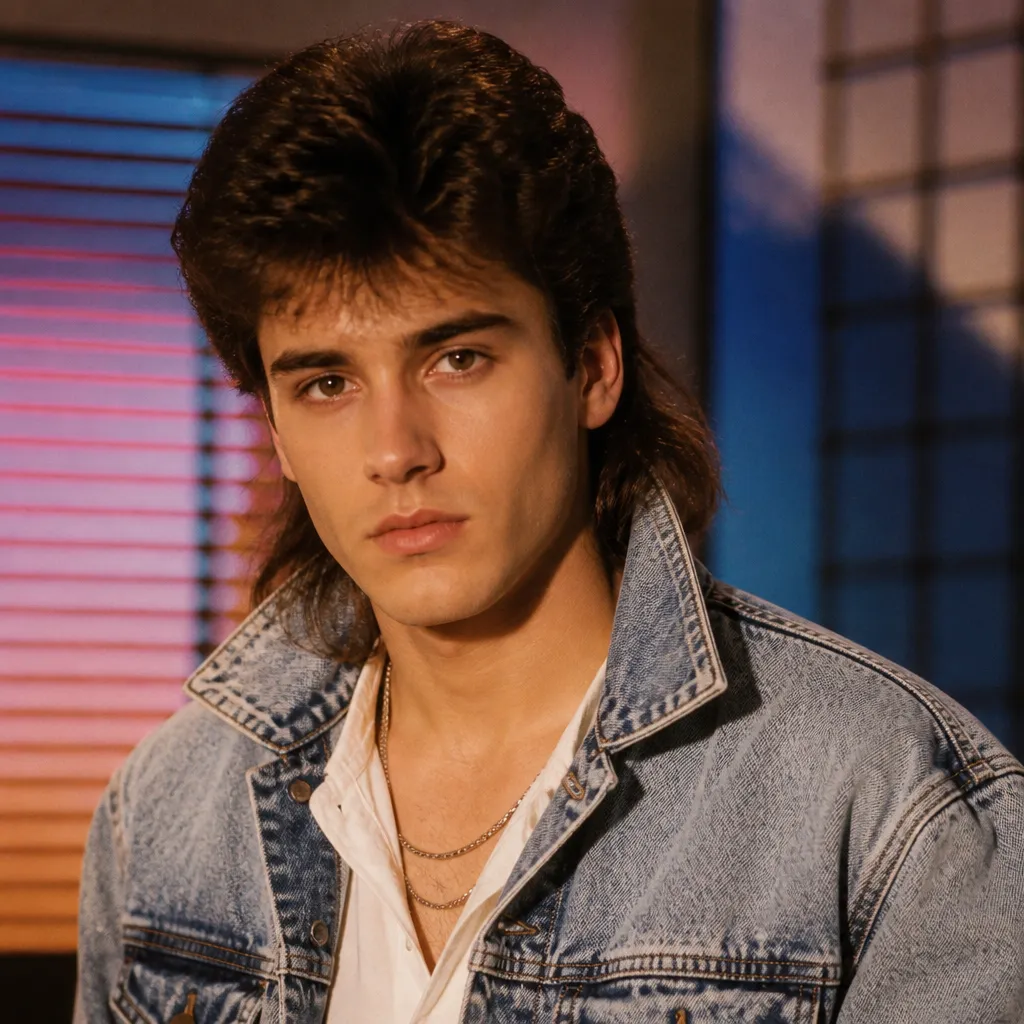
Accessories also define much of the 80s style.Mirrored glasses, thick chain necklaces, large ears and hair bars were virtually ubiquitous.When asking the AI to recreate your image in this style, mention specific accessories that you would like to have added.The more detail you provide about the desired result, the closer to your vision the system will be able to get.
Makeup was also much more dramatic at that time: colored shadows, marked eyeliner, reddish blush and vibrant lipstick. The cejas were often thicker and more natural, contrasting with the elaborate makeup around the eyes. If you want a result that captures the essence of the 80s well, allow the AI to apply makeup in this style, even if you normally wear something that makes up the essence of the real life.
Avoiding Proportion Errors and Facial Disproportion
One of the most visible errors in poorly executed AI transformations is facial disproportion. When the AI does not correctly map the original face, it can generate too large or too small eyes, disproportionate nose or elongated chin. This happens especially when the base photo has extreme angles or inadequate lighting, as mentioned earlier.
AI creates transformations based on learned patterns, and if the original face is not well mapped, the result may appear asymmetrical or “weird”.If you notice that one side of the face in the transformed image looks different from the other, this usually indicates a problem in the original mapping.
Bulky hair from the 80s can easily overtake the correct proportions of the face if it is not well calibrated by AI. An extremely voluminous hair can make the face look too small or disproportionate.If this happens, do not hesitate to edit the image afterwards, slightly reducing the volume or adjusting the shape. Many simple editing tools allow these adjustments without compromising the overall quality of the image.
Another problem is when the neck or shoulders are disproportionate to the transformed head. This is because AI focuses primarily on the face, and the rest of the body may not scale proportionally.If the final image shows a very thin neck compared to the added hair and accessories, use editing tools to better balance this ratio.
Refining Results Through Complementary Editing
After AI generates its transformation in the 80s, you do not have to consider the result as absolutely final. Many simple and affordable editing tools allow adjustments that significantly improve the result. You can adjust contrast, color saturation, brightness and even remove small imperfections that AI may have created.
Color correction is especially useful after AI applies 80s style. Sometimes hair color can be adjusted to a more vibrant or paler shade as per your preference. Clothing colors can also be refined if you find that they did not look exactly as you imagined. A small adjustment in saturation or hue can turn an “almost perfect” image into exactly what you viewed.
Editing details such as accessories is also common and recommended. If the AI has added a necklace that does not match well or if an earring has become poorly positioned, cloning or repair tools allow you to correct these elements. These edits require patience, but result in a much more polished image and close to your ideal.
Do not underestimate the power of simple brightness and contrast adjustments. Sometimes an image transformed by AI will be too high or too low contrast, compromising the overall appearance.A small adjustment to these parameters can restore naturalness and make the transformation look more believable and visually appealing.
Understanding Realistic Limitations and Expectations
It is important to understand that, however advanced, AI still has limitations. If you upload a photo where your face is partially covered or at extreme angle, no amount of processing will be able to overcome these fundamental limitations. AI works with the available data, and insufficient or low-quality data results in less convincing transformations.
Different AI tools produce varying results, some with greater facial accuracy, others with better styling application.If one tool does not produce the result you expected, try another.Each system has its strengths and weaknesses, then do not give up after a single attempt. Persistence often results in discovering the perfect tool for your specific needs.
Also keep in mind that AI recreates your face based on patterns learned from real people of the 80s, but still creates something unique that reflects your facial features combined with historical styles.The result will never be exactly as you imagined it, because human creativity and machine interpretation work in different ways. Accepting this reality helps you to better appreciate what AI can deliver.
Technology has improved exponentially in recent years, and it keeps improving.If you try today and not be completely satisfied, try again in a few months when new versions are released. Progress in AI is steady, and transformations that seem impossible today may be trivial soon.