
Scan Your Car Engine Now
Anúncios
Automotive technology has evolved significantly, and you can now diagnose engine problems in your car without relying solely on a workshop. Scan your vehicle engine using modern tools and identify faults before they become costly.
In this comprehensive guide, you will learn how diagnostic scanners work, what are the best practices for performing a proper reading and how to interpret the results obtained.We will cover real use cases, practical scenarios and situations where this technology makes all the difference in preventive maintenance of your car.
What It Means to Scan Your Car Engine
Scanning the engine is a process of reading the diagnostic codes stored in the electronic control unit (ECU) of your vehicle. When an anomaly is detected by the sensors distributed by the engine, the ECU records a fault code that can be recovered through a special device. This process does not damage anything in your car and provides valuable information about the state of the mechanics.
The diagnostic system of your car works continuously, monitoring dozens of parameters such as engine temperature, fuel pressure, catalyst operation and gas emissions. When something goes outside the standards set by the manufacturer, an error code is generated and stored in the memory of the ECU. You can retrieve this information using an OBD2 (On-Board Diagnostics 2) scanner, which is the world standard for vehicle diagnostics.
Why You Should Scan the Engine Regularly
Preventive maintenance is much more cost-effective than fixing advanced problems.When you scan the engine regularly, you can identify small faults before they turn into serious and expensive defects.A faulty oxygen sensor, for example, can be fixed quickly when detected early, but can damage the catalyst if ignored for too long.
 ELM OBD2 Car Scanner
Classification:
”’ think it’S.
4.81
Age Classification:
Free Classification
Author:
CAR SCANNER LLC
Platform:
Android
Price:
Free
▶Download on Google Play
ELM OBD2 Car Scanner
Classification:
”’ think it’S.
4.81
Age Classification:
Free Classification
Author:
CAR SCANNER LLC
Platform:
Android
Price:
Free
▶Download on Google Play
In addition to the financial issue, scanning the engine contributes to the safety of your vehicle. Failures in the brake system, airbag or suspension can generate error codes that a scanner identifies immediately. You avoid dangerous situations by staying informed about the actual mechanical state of your car. Many accidents could have been avoided if the driver had performed a diagnostic reading at the right time.
Engine performance also improves when you work with accurate information about your condition. An engine with a recorded failure can consume more fuel, lose power and generate emissions above the allowed. By correcting the problems identified by the scanner, you regain the original efficiency of your vehicle.
How to Use an OBD2 Scanner to Scan the Engine
Using an OBD2 scanner is much simpler than you might think. First, locate your car’s diagnostic port, which is usually underneath the instrument panel, on the driver’s side. Plug the scanner into that port and wait a few seconds for the device to communicate with the ECU. Most modern scanners establish communication in less than 5 seconds.
After connection, the scanner will display a start menu where you will select the option to read fault codes. Some devices do this automatically, while others require manual navigation through the menu. The process is fast and you will receive a list with all the codes stored in the engine memory. Each code has a specific meaning and references that help identify which vehicle system is generating the problem.
After obtaining the codes, the scanner usually provides additional information such as the state of the catalyst, real-time sensor data and fault history. You can take screenshots or print the results to lead to a mechanic if necessary.Some professional scanners also allow you to erase the stored codes, but this action must be done with caution so as not to mask real problems.
Types of Scanners Available for Vehicle Diagnosis
There are different levels of scanners on the market, each suitable for specific needs. Basic scanners are affordable and read only stored fault codes, working for general and simple diagnostics.These devices are sufficient for most private car owners who want to monitor the basic health of the engine. You can find them at quite competitive prices in auto parts stores.
Advanced scanners offer more robust functionality, including real-time data reading, specific sensor testing, and even programming of electronic components.These devices are often used by professional mechanics who need detailed information for complex diagnostics.The learning curve is more steep, but the quality of information is superior.
Currently, you also have the option of using Bluetooth adapters that connect to your car’s OBD2 port and communicate with an app on your smartphone. These devices eliminate the need for a dedicated scanner and allow you to access diagnostic information directly on your phone. The convenience is immense, especially for regular vehicle monitoring during the week.
Real Use Cases: When Scanning the Engine Makes a Difference
Consider a real scenario where you have been driving your car for a few months and note that the check engine light has turned on the dashboard. Initially, you may think about washing the car or calling a reliable mechanic, but the truth is that this light can indicate from a minor problem like a loose fuel cap to a complex failure in the injection system. By scanning the engine immediately, you get accurate information about which system is generating the alert.
Imagine that you travel often with your family and know that reliability is essential. Using an OBD2 scanner before a long trip allows you to identify potential problems and fix them in advance. You may find that the oxygen sensor is failing, that the battery is weakening or that there are problems in the emissions system. With this information, you make informed decisions about whether it is safe to travel or whether you need to do a preventive review.
Another practical scenario involves buying a used car. Many people want to confirm that a second-hand vehicle is really in good condition as the seller states. By scanning the engine before making the purchase, you have access to the history of recorded failures and the current state of the sensors. This offers protection against impulsive purchases of cars with hidden problems. You can negotiate better when you have reliable technical information.
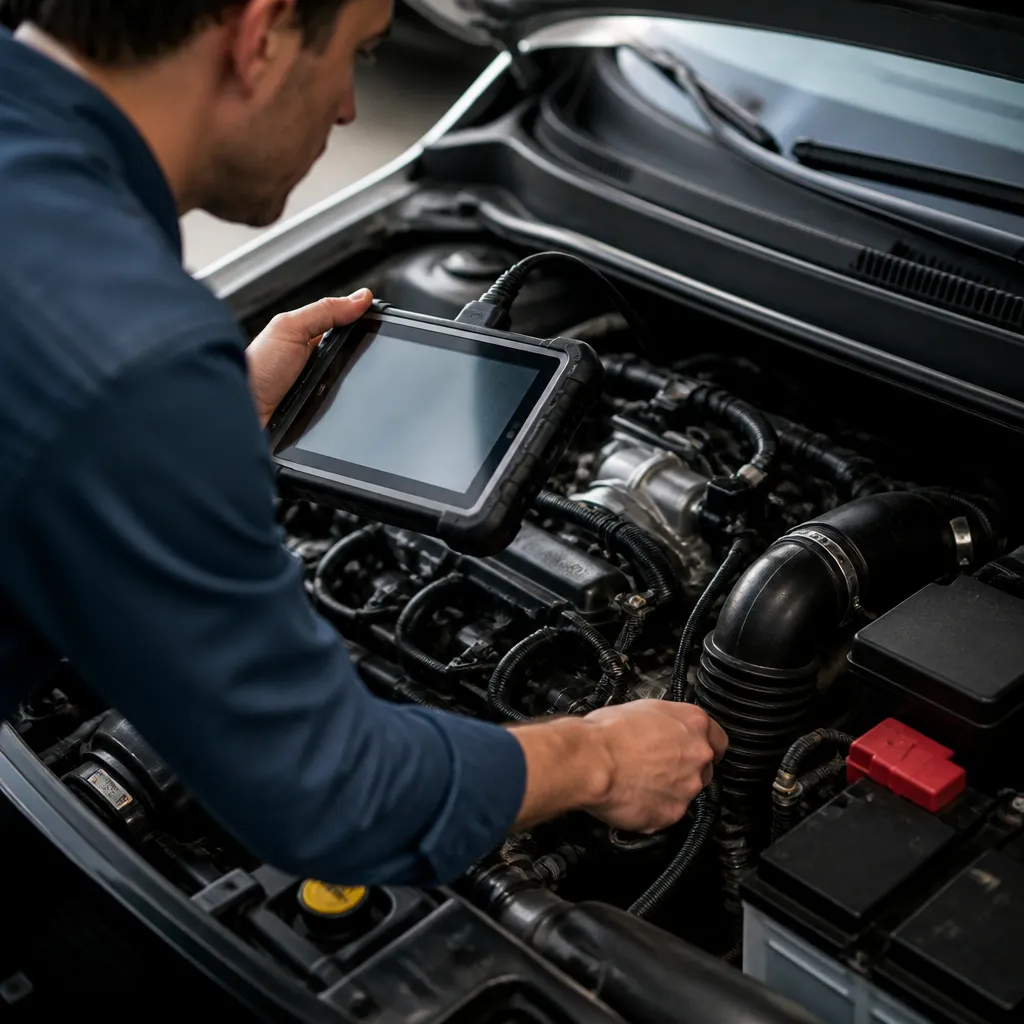
Companies that maintain vehicle fleets also benefit greatly from regular engine scanning. By maintaining a periodic diagnostic schedule, these organizations significantly reduce vehicle downtime.A delivery truck that stops mechanical failure not only spends on repair, but also affects the deliverability and reputation of the company.Preventive scanning identifies problems before they result in unplanned downtime.
Interpreting the Failure Codes You Find
OBD2 codes follow an international standard where each code is formed by a letter followed by four numbers. The initial letter indicates the problem category: P stands for Powertrain (engine, transmission and related systems), B stands for Body (comfort and safety systems), C stands for Chassis (steering and brakes) and U stands for Network (communication between modules). Understanding this basic structure helps you quickly categorize the severity of the problem.
The first two numbers in the code indicate the affected subsystem. For example, codes starting with P01 refer to the fuel system, while P02 refers to the fuel injection system. The third and fourth numbers identify the specific component or sensor that is generating the failure. This standardized organization allows you to quickly search for the exact meaning of any code found by the scanner.
Permanent codes indicate ongoing problems that the system has detected on multiple occasions and that must be investigated and corrected. Temporary or intermittent codes may appear once or twice and disappear, often related to loose connections or temperature-sensitive sensors. A suitable scanner tells you what type of code you are viewing, allowing you to assess the urgency of the correction required.
Practical Solutions Based on Scanning Results
When you identify a fault code through engine scanning, the next step is to determine whether the problem can be solved yourself or if it requires professional. Simple problems such as a poorly fitted fuel cap, loose sensor connections or corrosive battery cables can be fixed on your kid with basic tools. Other problems such as fuel injector failures, transmission problems or emissions system defects require specialized knowledge and equipment.
For many common problems, the scanner itself provides repair recommendations. A code indicating engine temperature sensor failure can be solved by cleaning the sensor contacts before replacing it. A faulty oxygen sensor is often solved with a simple replacement that you can do at home if you have experience. The important thing is to always consult your vehicle manual or a reliable mechanic before attempting serious repairs.
Another practical aspect is the cost-effectiveness of different solutions. You can choose to repair immediately when the code is identified, saving on future secondary damage. Alternatively, you can monitor the code for weeks or months if it does not affect the daily operation of the car. A code related to a non-critical sensor can be monitored more smoothly than a code that affects safety or emissions. Regular scanning provides data for this responsible decision making.
Keeping a History of Engine Scans
An excellent practice is to keep records of the scans you perform on your car. This creates a technical history that documents the health of the vehicle over time. If you scanned the engine monthly for one year, you will have information about what the state was in each period and can identify degradation patterns. A sensor that begins to show abnormal readings can be tracked before generating a permanent fault code.
This history is particularly valuable if you plan to sell the car in the future. Showing prospective buyers a consistent record of maintenance and regular scans significantly increases confidence in the transaction.You can demonstrate that you have responsibly taken care of the vehicle and that there are no hidden surprises waiting for discovery.Some buyers even offer higher prices for cars with documented history of preventive maintenance.
Also, keeping records helps you plan future maintenance expenses.If multiple scans show the gradual degradation of a component, you can financially prepare for its replacement. This preparation avoids unpleasant surprises and allows you to perform repairs at the best time, not necessarily when total failure occurs.
Documentation also benefits future mechanics working on your car. By leaving records of previous scans, you provide valuable context that speeds up diagnostics and avoids repeating unnecessary tests.A professional who knows a sensor has been recently tested can focus their attention on other aspects of the problem, saving time and money.
Modern Technology for Remote Engine Scanning
Technological developments have brought increasingly affordable ways to scan your car’s engine.Small, affordable Bluetooth adapters connect to the OBD2 port and transmit data to an app on your smartphone.You no longer need a dedicated and expensive scanner; anyone with a modern phone can diagnose engine problems. Convenience is transformative, especially for owners who want frequent monitoring without significant investment.
Some of these Bluetooth adapters offer advanced features like real-time monitoring of engine parameters, immediate fault alerts, and detailed reports saved in the cloud. You can leave the adapter permanently connected to your car and receive notifications whenever a fault is detected. This continuous surveillance provides additional protection against problems that may develop between visits to the workshop.
Connected platforms have also emerged, offering vehicle diagnostic services through sophisticated applications. These solutions integrate data from multiple scans, maintenance history, review reminders and even suggestions from nearby repairers.The modern technological ecosystem makes your car maintenance much more accessible and informed than it was just five years ago.
The trend of newer vehicles is the native integration of even more advanced diagnostic systems.Many cars manufactured in recent years have integrated connectivity that automatically communicates with the manufacturer about the state of the vehicle. Understanding how these systems work and how you can access this information puts you in a position of control over the maintenance of your own car.