Night Vision App: See in the Dark
Anúncios
Seeing in the dark is no longer the privilege of action movie protagonists and secret agents. Today, anyone with a smartphone can turn the device camera into a real night vision equipment through specialized applications. These programs use artificial intelligence and advanced image processing to amplify the available light and offer clarity in low-light environments.
The market for night vision applications has grown significantly in recent years, following the evolution of camera sensors of modern smartphones. The technology that once required expensive professional equipment is now within reach of any pocket, democratizing access to tools that were previously restricted to specialized professionals.You find solutions for the most varied purposes: home security, night adventures, inspections of environments and even amateur astronomy.
How Night Vision Technology Works in Applications
Night vision apps work through sophisticated algorithms that capture multiple frames of the camera at high speed and combine them to create a clear, well-lit final image.The process, known as image stacking or image stack, leverages every photon available in the environment to build a composite image with much more detail than a single capture would allow. This technique is similar to the processes used in professional astrophotography, but optimized to work in real time on a smartphone.
In addition to the image stack, these applications employ contrast enhancement and noise reduction techniques that preserve visual quality even in extremely dark environments.Artificial intelligence analyzes patterns in the image and distinguishes real details from unwanted artifacts, significantly improving the user experience.Some applications also allow manual adjustments of exposure, gain and white balance, giving the user fine control over the final result of the capture.
The performance of these applications depends heavily on the quality of your smartphone’s camera and the availability of ambient light, even if minimal. Cameras with larger sensors and large aperture lenses (such as f/1.7 or f/1.5) produce significantly better results in low-light environments.
 Night Camera Photo Video
Classification:
^^^^^^^^^^^^^^^^^^^^^^^”’
3.92
Age Classification:
Free Classification
Author:
Aaru Soft Word
Platform:
Android
Price:
Free
▶Download on Google Play
Practical Applications in Day to Day
One of the most common uses of night vision applications is home security and environment monitoring. You can use your smartphone to check dark areas of your home at night, inspections in basements, garages or gardens without the need for flashlights or additional lighting.Many users also use these applications to record security videos in environments where installing conventional cameras would be impractical or very costly.
Camping and notary outdoor activities also benefit greatly from this technology.You can explore night trails, observe wildlife without interfering with their natural behavior, and document moments that would be invisible to the naked eye.Amateur photographers discover in these applications a valuable tool for composing night scenes, allowing visual planning before capturing the final photo with professional settings in dedicated applications.
Professionals in various areas also find value in these applications.Infrastructure inspection in dimly lit locations, equipment maintenance in dark areas, and construction work extending into dusk can be facilitated by night vision offered by these programs.Vetinarians and biologists use technology to observe and document nocturnal animal behaviors without causing stress to the observed specimens.
Current Trends in Night Vision Applications
The integration of convolutional neural networks (CNNs) represented a major advance in the capabilities of modern night vision applications. These networks learn complex patterns in low-light images and are able to reconstruct details that would be imperceptible with traditional algorithms.The result is a more natural image with fewer unpleasant visual artifacts, making the experience much more professional and useful for practical applications.
Another important trend is the combination of multiple camera sensors for even better results. Smartphones equipped with ultra-wide cameras, telephoto lenses and depth sensors are now able to offer more versatile and accurate night vision capabilities. Some modern applications take advantage of these multiple sensors simultaneously to create compositions that previously required sophisticated external equipment.
The increase in real-time processing capacity has also transformed the market. Current mobile processors are able to run complex computer vision algorithms without excessive battery drain, allowing long sessions of use in nighttime environments.This has created an opportunity for applications with premium features that offer advanced customization, high-resolution export and even 4K quality video recording with night vision enhancements.
Best Practices to Maximize Results
Cleaning the camera lens is critical to getting better results with any night vision application.Dust, fingerprints and dirt on the lens significantly reduce the amount of light reaching the sensor, impairing image processing. Simply wiping the lens with a soft cloth can make a dramatic difference in the quality of the captured image, especially in environments with very low brightness.
Positioning and stabilizing the device are equally important for getting clear images in night vision. Since the app works by combining multiple frames, any movement during capture will result in blurry or blurry images. You must use a tripod, support the smartphone against a stable surface or use your hands as firmly as possible. Some apps offer fast burst modes that allow you to capture multiple frames with small acceptable movements.
Understanding the trade-off between sensitivity and image quality is crucial to mastering these apps. Overly increasing gain (ISO equivalent) will result in clearer images but with more visual noise that can detract from fine detail.You need to find the right balance for your specific situation by testing different settings and evaluating the results in real time through your smartphone screen.
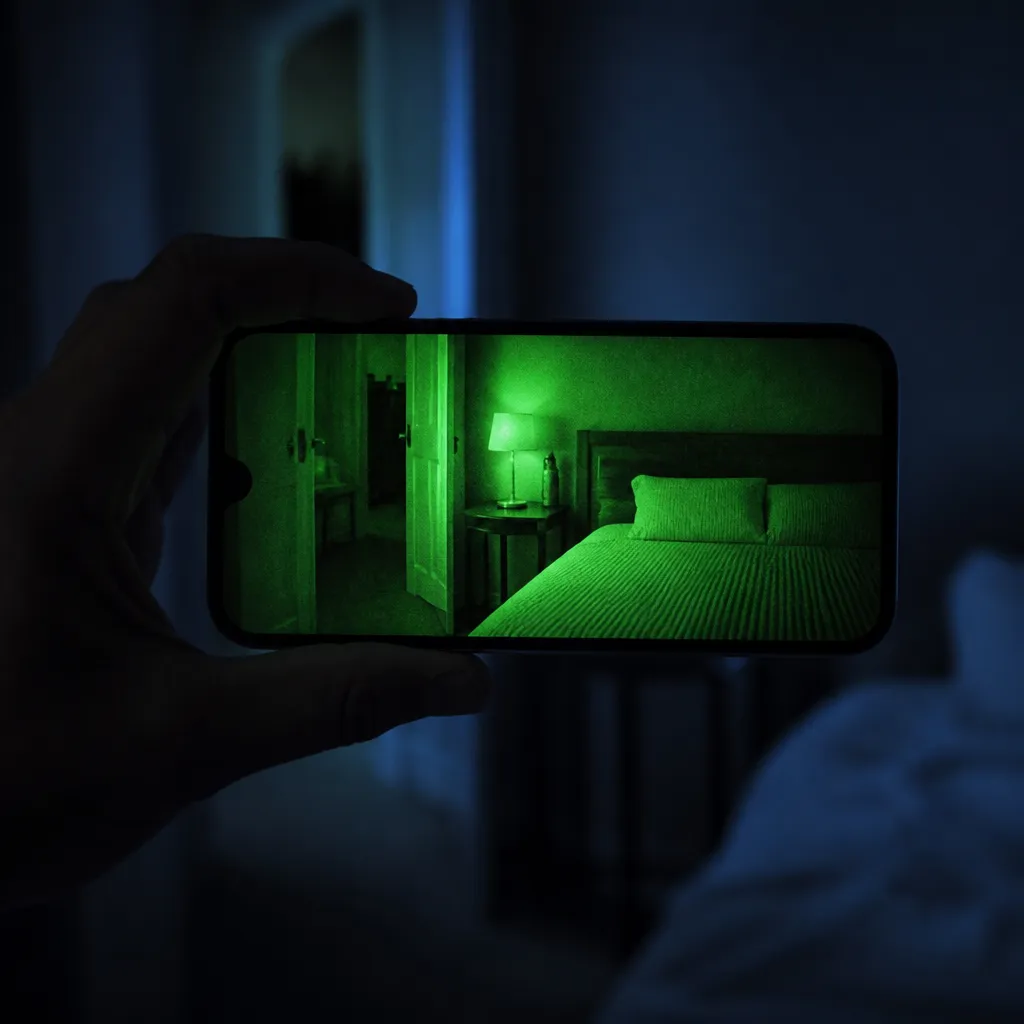
Maintaining an appropriate distance between the camera and the object of interest produces better results than trying to capture very small or very close details.You should test different distances and zoom to find out which range works best with the specific app you are using on your smartphone.
Comparison Between Different Categories of Applications
There are real-time focused night vision apps designed to display continuous feeds with improved brightness and clarity. These programs are ideal for exploration, immediate safety, and room observation.They work as a substitute for portable night vision goggles, allowing you to see real-time details without noticeable delay.Visual quality is usually slightly lower than static apps, but instant response pays off for most practical applications.
Another important category comprises applications specialized in capturing static photos with advanced processing. These programs devote more computational power to post-capture processing, resulting in higher quality images, more preserved details and less visual noise. The trade-off is that capturing takes a few seconds and requires a lot of device stability. You should use tripod or stable surfaces when capturing with these applications to avoid blurry images.
Night vision applications for video recording represent a third specialized category. These programs optimize image processing to work on continuous video streams while maintaining acceptable quality while working with the computational limitations of processing multiple frames per second.Video visual quality is generally lower than in still photos, but the result is fully usable for documentation and security.
Privacy Considerations and Legal Responsibility
The use of night vision apps raises important questions about privacy and legality that you need to carefully consider. In many countries, photographing or filming people in situations where there is expectation of privacy is illegal, even in public environments.You should always check local laws before using any night vision app to capture images of other people, other people’s properties or private environments.
Video recording in other people’s homes or private areas without consent is particularly problematic legally. Even if you have access to the site, documenting other people’s activities without authorization may result in civil or criminal prosecution depending on jurisdiction.
Professionally, documenting inspections or maintenance work on foreign properties with night vision requires clarity about image rights and intellectual property of the captured material. You need to establish clear agreements with customers about who has rights to the material, how it will be stored and whether it will be shared. This transparency protects you legally and establishes professional trust with those involved.
The data security of captured images also deserves attention.Many applications automatically store photos and videos in cloud services or in synchronized directories.You should check the privacy settings of the chosen application and decide to raise awareness about where your night vision images are stored and who has access to them.
The Future of Night Vision Technology in Smartphones
The future trajectory of night vision applications points to visual quality that is increasingly close to that captured by professional equipment. The continued advancement in camera sensors, mobile processors and artificial intelligence algorithms will create scenarios where you will be able to capture nighttime images virtually indistinguishable from daytime photos in terms of clarity and detail.
Augmented reality (AR) integrated with night vision represents another promising frontier.You will be able to not only see in dark environments, but also overlay real-time information, measurements and contextual data on what you are seeing.Professional applications will use this combination for more accurate inspections, more efficient maintenance and more complete security analyses.The technology will allow you to capture not only images, but rich context about the observed environments.
The expansion of the infrared spectrum is also a trend expected soon. Smartphones with dedicated infrared sensors will allow applications not only for amplified vision of visible light, but for real thermal detection.You will be able to see heat sources and map temperature differences in completely dark environments, opening possibilities for infrastructure inspection, thermal leak detection and scientific research that previously required expensive specialized equipment.
Integration with smart home and IoT ecosystems will further power night vision applications.You will be able to control smart lighting synchronously with night vision applications, automatically adjust camera settings based on environmental sensor data, and even synchronize multiple devices to create complete security panoramas in nighttime environments.