App to See Who Visited Your Profile
Anúncios
Have you ever wondered who is visiting your profile on social networks? This is one of the most frequent questions among users of platforms such as Instagram, Facebook and TikTok.There are applications that promise to reveal exactly who viewed your profile, but not everything you hear about them is true.
In this article, we will separate the myths from the truths about the apps from seeing who saw your profile. You will understand how they work, what are the real limitations, the security risks involved and how social networks themselves deal with this issue.
What Are Apps to See Who Visited Your Profile
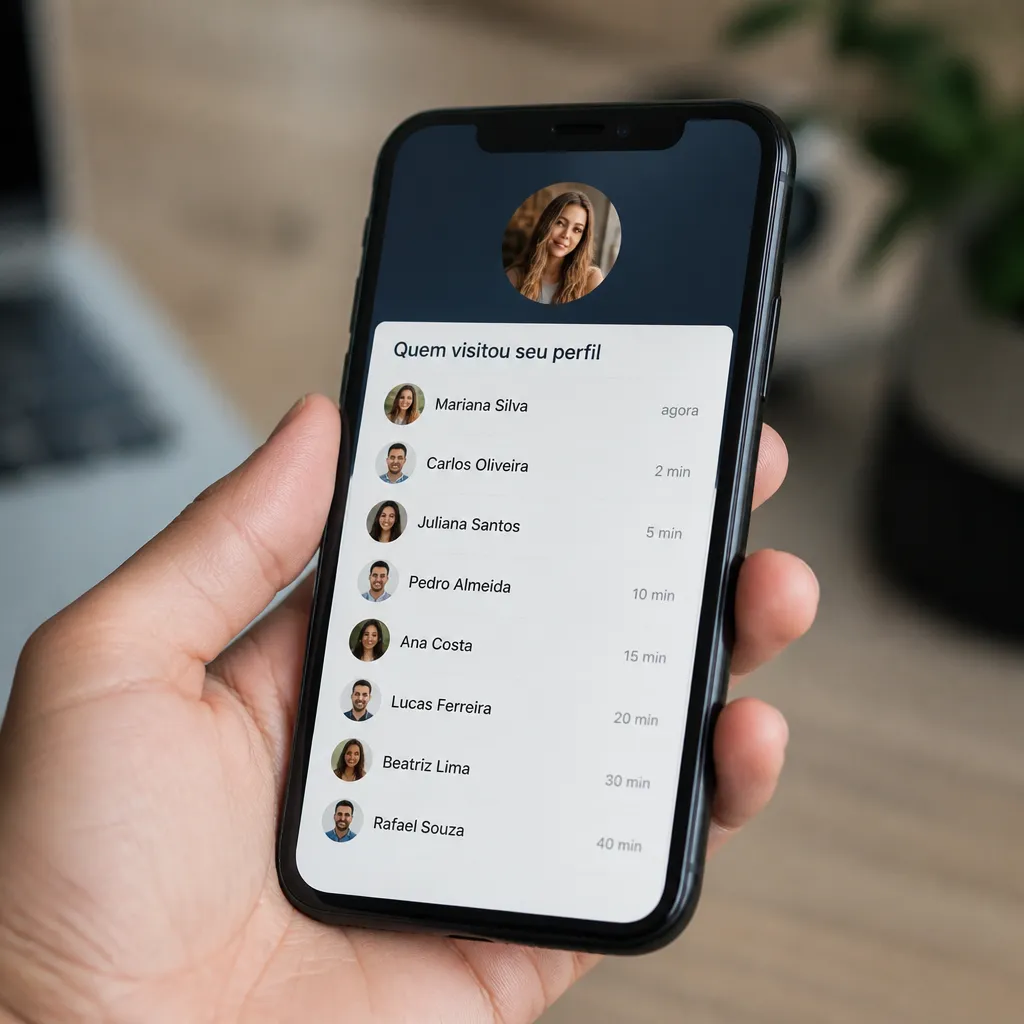
Apps that promote the view of who visited your profile are tools developed by third parties that try to access data from social networks. They work by asking permission to connect to your account and theoretically tracking the actions of other users in your profile. There are versions for Android, iOS and also extensions for browsers.
The purpose of these apps is simple and attractive: show a complete list of people who viewed your profile, how many times they visited and at what time. For you, user, this sounds irresistibly useful, especially if you want to know who is really interested in you. However, the reality behind this promise is much more complex than it seems.
Myth: These Apps Really Work
One of the biggest illusions is to believe that any application can accurately reveal who viewed your profile. The truth is that social networks, particularly Instagram and Facebook, do not provide this information to third-party applications.The privacy policies and terms of service of these platforms explicitly prohibit sharing profile view data with external.
 Social Guru
Age Classification:
Free Classification
Author:
Mobi Connect Trek
Platform:
Android
Price:
Free
▶Download on Google Play
Even if an app says it works, it can’t access the actual data from the platform.This means that any list you receive is randomly generated, based on algorithms that have no connection to who actually visited you. The app may simply be showing random names of people you already follow or who are in your network of contacts.
If you tried such an application and thought it worked because it recognized some names, know that this is pure coincidence. With millions of users on each social network, the chances of some random names matching people you know are extremely high.
Truth: Instagram and Facebook Have Official Limited Features
Here’s an important truth: Instagram and Facebook offer some official and limited features for you to see data about who interacts with you, but not about who simply views your profile. Instagram Stories lets you see who saw your stories, but only those shared in the stories, not your profile in general.
On Facebook, you can access basic insights about your followers if you have a professional page. These insights show demographic information and engagement levels, but do not identify specific names of people who have visited your profile. TikTok offers a feature called “View Analytics” for creators that allows you to see data about who watched your videos, but does not offer information about profile views.
The reason why social networks do not make this data available is deliberate. They maintain this privacy to protect their users and avoid obsessive or harassing behaviors.If everyone could see exactly who visited their profiles, many uncomfortable and potentially dangerous situations could happen.
Myth: Your Data Is Safe in These Apps
Many people believe that even if these apps do not work, at least they are safe to use. This is one of the biggest illusions and a real risk that you run. When you authorize a third-party app to access your social networking account, you are literally handing over your credentials and personal information to an unknown company.
These apps often ask for very broad permissions, such as full access to your account, ability to post content on your behalf, and even view direct messages. Once these permissions are granted, the app can do just about anything with your data.Many of these apps are used by hackers to steal information or hijack accounts.
Some of these apps collect your login data and sell it to criminals, who then use that information to access your account in an unauthorized way.Your photos, private conversations, and other sensitive information can be compromised.
Truth: Security Risks Are Real and Documented
Cybersecurity experts have for years warned of the dangers of these apps.There are documented reports of accounts that were hacked, hijacked or used for spam after users authorized suspicious apps.
Platforms like Instagram and Facebook themselves often remove these apps from their servers when they discover they are trying to access data without authorization or in a malicious way. You may receive notifications that an app you used has been disabled or has had its permissions revoked.
Also, many of these apps ask for unnecessary permissions that have nothing to do with the promised function. If an app that says “see who saw your profile” asks for access to your camera, microphone, or location, you know there is something wrong. These additional permissions often indicate that the app has malicious intentions beyond just showing preview data.
Myth: Browser Extensions Are Safer
Some people think that using browser extensions is safer than downloading a full-featured application.The truth is that browser extensions can be equally dangerous, if not more. A malicious extension can track everything you do on the internet, steal your passwords, collect credit card information, and monitor your online activities.
Extensions have deep access to your browsers and the data you enter into them. An extension that would promise to show who visited your profile would be tracking your interactions on the social network and potentially on other websites as well.Many extensions you find in official stores were created with bad intentions, and even well-intentioned ones can be maliciously updated in future versions.
The problem is that you don’t really know who created the extension or what the real intent behind it is. Even if it looks legitimate and has good reviews, fake reviews are extremely common.Criminals who develop these extensions often buy positive reviews to make the product more attractive and fool more users.
Truth: Social Media Actively Fights These Apps
You may not know it, but Instagram, Facebook, TikTok, and other social networks have dedicated teams specifically to combat unauthorized applications that attempt to access your data.These companies regularly change their APIs (programming interfaces) and their security measures to prevent third-party applications from scraping data or accessing information they should not.
When you authorize an application through a login with your social network account, you are usually using what is called OAuth, a protocol that should only allow certain accesses.Social networks constantly monitor to detect when applications are trying to access more data than they should or improperly using the permissions granted.
If you notice that an app you used before no longer works, it probably means that the social network has detected malicious activity and blocked access. Platforms also send notifications when you authorize apps, and you can revoke these permissions at any time.
Myth: Only Some Apps Are Dangerous
There is a common belief that only a few dubious apps are dangerous, and that apps with known names or that look professional are safe.The reality is that virtually all apps that promise to show who visited your profile have some level of risk.
The problem is fundamental: no legitimate application can really do what it promises, because social networks do not provide this data. This means that any application in this niche is necessarily deceiving you about its capabilities. If the application is lying about its main function, there is reason to distrust other aspects of it as well.
You also need to consider which apps may look safe for years and then be sold to a malicious owner.The history of the internet is littered with examples of apps and services that started with good intentions and then were compromised.The app you trusted yesterday can be totally different and dangerous today.
Truth: You Can Check Which Apps Are Permitted in Your Account
You may not have noticed, but any app you have authorized to access your account leaves a trace. On Instagram and Facebook, you can access your settings and see all the apps connected to your account. This is a way for you to check if you authorize something suspicious in the past and remove those hits immediately.
To do this on Instagram, go to Settings, then Apps and Sites, and you will see a complete list of everything that has access to your account. You can see exactly when each app has been authorized and what permissions it has. If you see something that you no longer recognize or need, you can remove access immediately with one click.
Facebook has a similar process in its security settings.This allows you to have full control over who can access your data. If you have used any of these profile view apps in the past, now is a good time to review this list and remove anything suspicious.
Myth: VPNs and Incognito Mode Protect You When Using These Apps
Some people think that if they use a VPN or incognito browser mode when accessing these apps, they will be protected. This is a dangerous myth because VPNs and incognito mode do not protect you from malicious apps that you have voluntarily authorized to access your account. The VPN encrypts your connection but does nothing against the malicious code inside the app.
Incognito mode simply means that the browser does not store cookies and history locally, but this also does not protect you from an application that you have authorized. If you enter your login into a malicious application, it will have your data regardless of whether you are in incognito mode. The malicious application may steal information directly from your browser memory or from your session.
True protection does not come from technical tools like VPN or incognito, but from simply not authorizing these apps in the first place.No amount of technical privacy protects you from a bad decision to authorize access to your profile.
Truth: Social Media Earn Money Keeping Your Data Private
An important perspective is to understand why social networks are so zealous in protecting certain data.Instagram, Facebook and TikTok make money mainly from targeted advertising.The data they collect about you is extremely valuable because it allows them to create more targeted ads.They do not want to share this data with competitors or third-party applications that could use them improperly.
In addition, revealing who viewed their profiles would create huge legal responsibilities.If someone is harmed because they discovered that they were discovered spying on a profile, the social network could be held accountable. Therefore, keeping this information private is not only a matter of privacy, but also of legal protection of the platforms themselves.
When you understand that social networks have so much financial and legal interest in keeping certain data private, it is clear that no application will be able to access it. Security is not a fluke, but a deliberate strategy of the largest technology companies in the world.
Myth: If An App Has Many Users, It Must Be Trusted
The number of downloads or users of an application is not a reliable indicator of security. Many malicious applications have millions of downloads because people fall into the illusion that something popular must be safe. In fact, popular applications are even bigger targets for hackers because they affect more people. The more users, the more data to steal and the more money to earn from selling this information.
In addition, malicious app developers often buy falsely inflated downloads to create the appearance of popularity. You may see an app with a million downloads, but half of them may be fake. Reviews are also often manipulated in the same way, with fake reviews praising the app that is actually dangerous.
The only reliable way to evaluate an app is to research it on security forums, check if cybersecurity experts warn against it, and read user reviews across multiple platforms.
Truth: You May Know Who Interacts With You in Other Ways
If you are curious about who is interested in you on social networks, there are legitimate and safe ways to get this information. On Instagram, you can check who left likes and comments on your posts. You can see who shared your stories. You can access the official statistics to better understand your general audience, even if you do not know specific names.
If someone important is regularly visiting your profile, chances are they will leave some evidence, like liking posts or leaving comments. People who really care about you often go beyond just viewing passively. This is a much more reliable way to gauge interest than relying on an app that makes impossible claims.
Another approach is to look at natural patterns.If you notice that the same person is appearing frequently in your comments or sharing your posts, you know there is real interest. These clues are much more significant than a random app telling you a name that may be completely false.
Myth: Apps to See Who Visited Your Profile Are Just A Little Risky
There is a tendency to underestimate the risk of these applications, thinking that “the worst that can happen” is that they do not work. In fact, the worst that can happen is much worse than you think. Your account can be completely hijacked, your identity stolen, your photos used for scams, your personal information sold to criminals and your device infected with malware.
There are documented cases of people whose account was used to send phishing messages to all their contacts, asking for money on their behalf. Others have had their photos stolen and used to create fake romance accounts.Some have suffered identity theft that took years to resolve. These are not hypothetical risks, but real consequences that happened to real people.
The risk is not “a bit” when you are dealing with your complete online identity. An improper authorization can have repercussions that you will face for months or even years.The convenience of theoretically knowing who visited your profile is simply not worth the real risk of having your online life destroyed.
Truth: Your Social Media Is Worth Much More Than This Knowledge
Put on the scale: on one hand, the curiosity to know names that are probably random; on the other, your entire account, your photos, your messages, your contacts and your online reputation.It is a very unbalanced decision. Your social network account is too valuable to risk with an application that does not really work and that can potentially destroy everything.
If you have already authorized any of these applications, the first thing to do is to revoke the permissions immediately. Go to your security settings, review all connected applications and remove anything that you do not recognize or do not need. If you have authorized something suspicious, consider changing your password as an extra precaution.
Knowledge is never worth it when purchased with the security of your account. You are much better off not knowing exactly who visited your profile than having your account compromised.The privacy that social networks maintain about profile views is actually a protection for you as well.