Automotive Scanner on Mobile: Diagnostic
Anúncios
The automotive scanner on mobile has transformed the way vehicle owners track the health of their cars. You can now diagnose engine problems, check fault codes and monitor critical components right from your smartphone, without having to take the vehicle to a workshop immediately.
Automotive Scanner on Mobile! DOWNLOAD NOW!
Vehicle diagnostic technology has evolved dramatically in recent years, and modern applications offer features that were once unique to expensive professional tools.With a simple Bluetooth adapter connected to your car’s OBD-II port, you have access to detailed information about engine performance and identifying potential problems that deserve attention.
How Mobile Vehicle Diagnosis Works
The automotive scanner on the mobile phone works through a communication protocol called OBD-II (On-Board Diagnostics), which is a mandatory international standard in vehicles since 1996 in the United States and since 2001 in Europe. Your car has a diagnostic port, usually located below the driver’s side control panel, where you connect a Bluetooth adapter that establishes communication with the application installed on your smartphone.
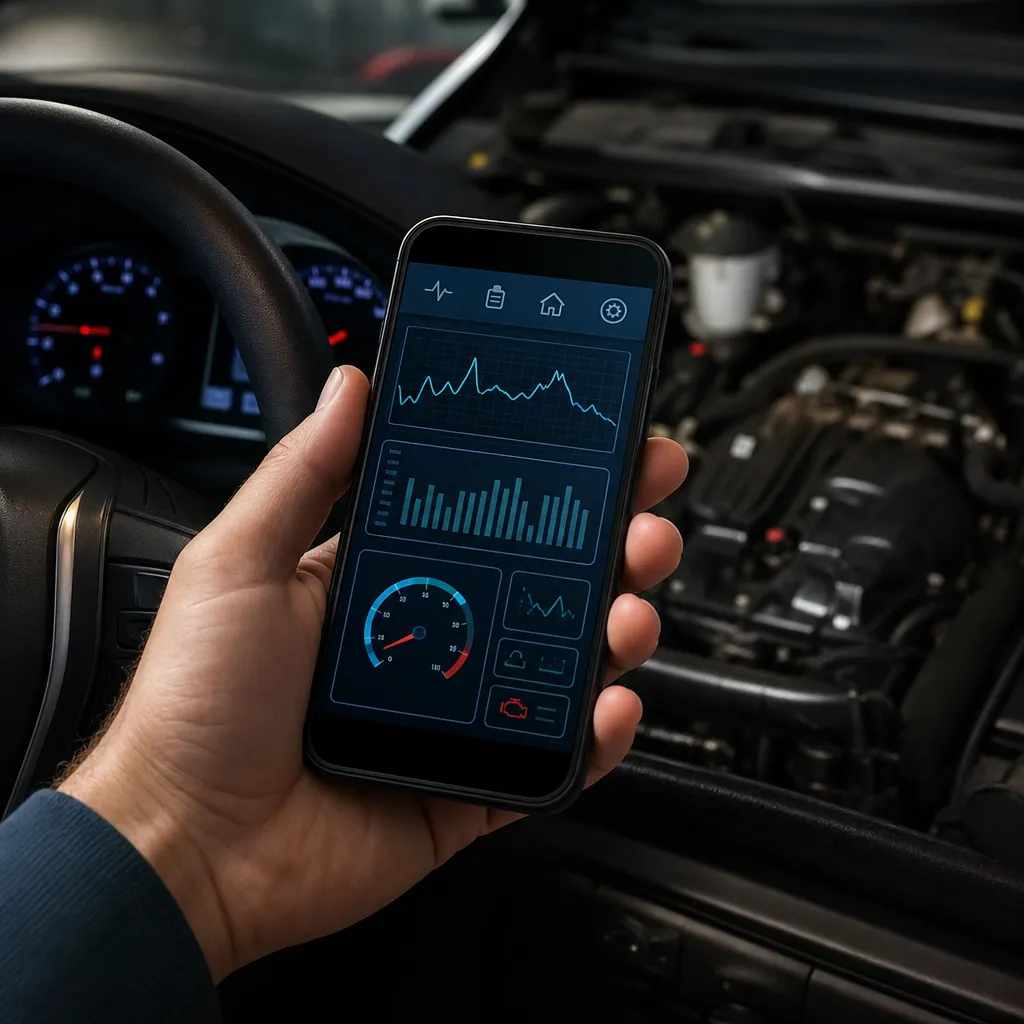
The Bluetooth adapter captures data from the vehicle’s on-board system and transmits it to the app, which decodes the information and presents it in an understandable format.You receive real-time readings on engine temperature, fuel consumption, revolutions per minute, fuel pressure, amount of oxygen in the exhaust gases and hundreds of other technical parameters that help identify problems before they become costly.
When a component malfunctions, the vehicle’s onboard system generates a specific error code called the Diagnostic Trouble Code (DTC). The application reads these codes and offers a clear language interpretation explaining what each error means and suggesting possible causes. This early diagnostic capability allows you to make informed decisions about maintenance and repairs.
Practical Advantages of Automotive Scanner on Your Smartphone
The convenience of having an automotive scanner on mobile is unmatched.You can check the status of your vehicle at any time and place, without relying on appointments in workshops or unnecessary outlays on paid diagnostics.Many owners save hundreds of dollars by identifying minor problems that could get worse and cause greater damage if they were not detected in time.
Financial savings are just one of the advantages.You also gain autonomy and knowledge about your own car, being able to better understand the mechanical behavior of the vehicle and talking to the mechanic in a more informed way. When you arrive at the workshop with a preliminary diagnosis, the professional can work more accurately and efficiently, saving time and money on unnecessary investigations.
In addition, many applications offer historical monitoring, allowing you to track the evolution of problems over time. You can compare readings from different dates, identify patterns and understand when a problem began to develop. This historical view is extremely useful for preventive maintenance and to provide detailed information to your trusted mechanic.
Some apps alert you when they detect issues that could compromise vehicle safety, such as airbag system failures, brake issues or issues in the suspension system.
Types of Adapters Available in the Market
There are different types of Bluetooth adapters compatible with the OBD-II port, each with specific features you should consider when choosing. Adapters vary in price, functionality, connection quality and compatibility with different vehicle models and smartphone operating systems.
The most popular adapters are small devices the size of a USB dongle that you connect to the diagnostic port and that remain there discreetly. Some models are ultra-small and practically invisible when inserted into the port, while others are a little larger but offer better heat dissipation and more stable connection. Most work with Bluetooth 4.0 or higher, ensuring compatibility with modern smartphones.
You will find adapters in different price ranges, from cost-effective models for less than fifty reais to premium devices that cost three hundred reais or more. The most expensive adapters usually offer better build quality, greater Bluetooth range, compatibility with more communication protocols, and more robust technical support.For most users, a medium quality adapter offers excellent cost-effectiveness.
Some adapters have advanced features like built-in GPS, built-in battery or even infrared cameras for more sophisticated diagnostics. You should evaluate your specific needs before investing in a premium adapter, as many of the advanced functions are not required for basic monitoring and diagnosing common problems.
Current Trends in Automotive Scanner Apps
Modern trends in automotive scanner applications indicate a move toward artificial intelligence and predictive analytics. Developers are investing in machine learning algorithms that can predict failures even before they happen, analyzing patterns in vehicle data collected over time.
Another important trend is integration with cloud services and connectivity platforms.Many modern applications allow you to synchronize your vehicle data with a cloud account, accessing it from any device and sharing information with authorized or family workshops for safety purposes.This connectivity provides a more complete view of your car’s maintenance and performance history.
Compatibility with newer vehicle systems is also a growing trend. Automobile manufacturers are increasingly integrated with smartphone technology, and scanner applications are keeping up with this evolution, offering support for newer vehicles and their more complex diagnostic systems.
Data security and privacy are becoming top priorities in new developments.As these apps handle sensitive information about your vehicle, developers are implementing more robust encryption, two-factor authentication, and more transparent privacy policies.
Best Practices when Using Automotive Scanner on Mobile
When you start using an automotive scanner on your mobile phone, establish regular monitoring routines to maintain a consistent record of your vehicle. Check key data such as engine temperature, fuel pressure and air consumption at least once a week, creating a history that will help you identify anomalies faster. Consistency is key to you noticing subtle changes that may indicate the onset of problems.
Whenever you receive an error code in the app, research the specific meaning of that code before worrying excessively. Some codes indicate minor problems that may resolve on their own after some runs, while others need immediate attention.Do not drive your vehicle aggressively or for a long time if the app indicates engine, brake or suspension system problems, as you may be putting your safety at risk.
Keep the Bluetooth adapter clean and in good condition by periodically checking that it continues to work properly. Moisture, excessive heat and vibrations can compromise the longevity of the device, so consider protecting it with a small cover or bag when not in use. Replace the adapter if you notice instability in the connection or inconsistent readings that do not make sense.
Use the historical comparison features of the app to track the evolution of problems. If you notice that the engine temperature is gradually rising over the weeks, this is a warning sign that deserves investigation before the problem becomes critical. These slow and gradual changes are often ignored if you just look at isolated readings, but historical patterns reveal the true health of your vehicle.
Do not rely on the application alone for critical maintenance decisions. Use the automotive scanner as a complementary tool to the professional knowledge of a reliable mechanic. When in doubt, take your vehicle for a professional inspection, as a mechanic can perform physical and visual tests that an application cannot do. The combination of digital diagnostics and professional expertise offers the best protection for your car.
Compatibility and Important Limitations to Know
Not all vehicles and applications are 100% compatible with each other. Cars manufactured before 1996 in the United States or before 2001 in Europe do not have the OBD-II port, making it impossible to use conventional automotive scanners in these vehicles. If you own an old car, checking the manufacturing date is essential before investing in an adapter and application.
Some car manufacturers, particularly European and Asian premium brands, implement proprietary diagnostic protocols that are not fully compliant with the OBD-II standard. In such cases, certain parameters may not be available or the app may not be able to read all error codes.
The quality of the Bluetooth connection is also a limitation that you may face. If your smartphone has poor Bluetooth or the adapter has limited range, the connection may disconnect during use, interrupting the diagnosis.Some applications are sensitive to interference from other nearby Bluetooth devices, such as headphones or smartwatches, which can affect the stability of the reading.
The application can read propulsion system parameters, emissions and some accessory functions, but it cannot access systems such as airbag, ABS brakes or adaptive suspension in some vehicles.If you need full diagnostics on these systems, you will still need to take your car to a dealership or specialized workshop that has more sophisticated professional equipment.
The application provides technical readings and error codes, but it does not replace the knowledge of a mechanic experienced in interpreting what these readings mean in the specific context of your vehicle. The same error code can have several different causes, and a specialized professional can determine what the real cause is through additional tests that an application cannot perform.
It is important to recognize that automotive scanner on mobile is an extraordinarily useful tool for monitoring and initial diagnosis, but it has clear technical and legal limitations.You should see it as a complement to professional maintenance, not as a substitute. Some countries have specific legislation on modifications in vehicle diagnostics, so make sure that the use of third-party applications is allowed in your region.
In addition to the price of the adapter and the app itself, some premium apps offer subscription plans for advanced features like predictive analytics or professional support.You should evaluate whether the initial, ongoing investment provides enough value for your specific vehicle owner needs.