
Mobile Crochet: Common Mistakes and How to Avoid
Anúncios
Learning crochet on your phone is totally feasible when you know the most common mistakes beginners make. This article will show you how to avoid traps that delay your learning and what is the most efficient way to start this practice correctly.
Technology has transformed the way people learn new skills, and crochet is no exception. Many beginners turn to applications, videos and digital platforms to acquire knowledge, but without proper guidance end up repeating mistakes that hinder their evolution. Understanding these flaws in advance saves you time, avoids frustration and accelerates your journey in the world of crochet.
The Most Common Mistakes When Starting Crochet on Mobile
The first mistake most make is to choose the wrong material to start. Many beginners see a visual crochet tutorial on mobile and start with too thin line or inadequate needle, thinking that so they will learn faster. Actually, this makes everything more difficult because the tension of the line becomes uncomfortable and you lose the clarity of work. The ideal is to start with thick lines (preferably in light tones) and larger needles, which allow you to better visualize each point and correct errors with ease.
Another frequent mistake is trying to learn multiple points at the same time. When you access a video on your phone about basic crochet, you usually find content mixing low, half high and high in the same sequence. This confuses the beginner and prevents him from mastering one pattern before moving on to the next. The correct thing is to completely master the low, practice dozens of times until doing automatically, and only then explore new variations of points.
Many beginners also do not give importance to posture and lighting when practicing crochet with accompaniment by the cell phone. Trying to learn while lying in bed or in a low light environment impairs your visual understanding and causes physical discomfort. You should sit in a comfortable chair with good lighting (natural light or LED lamp), and keep the cell phone in a position where you can see both the tutorial and your work simultaneously.
 Learn to crochet
Classification:
^^^^^^^^^^^^^^^^^^^^^^^”’
4.33
Age Classification:
Free Classification
Author:
Yoana Kollinger Apps
Platform:
Android
Price:
Free
▶Download on Google Play
Learn to crochet
Classification:
^^^^^^^^^^^^^^^^^^^^^^^”’
4.33
Age Classification:
Free Classification
Author:
Yoana Kollinger Apps
Platform:
Android
Price:
Free
▶Download on Google Play
Choosing the Right Material for Beginners
The quality of your starting material determines much of your success when learning crochet.Line lines of low quality or very thin cause frustration because they break easily, embarrass and do not allow you to see the points clearly. Look for cotton or acrylic lines of good origin, with thickness between 4 and 6mm (equivalent to larger rolls), which are easy to work and forgive small mistakes.
Crochet needles also make a huge difference in the learning experience. Needles that are too thin or of poor quality become rough and make it difficult to slide the line. It is recommended to choose aluminum or bamboo needles, in measures 4 to 6, that combine well with the lines we suggested earlier. When you can insert the needle gently into the line and slide it without excessive resistance, everything becomes more fluid and intuitive.
Be sure to also invest in quality scissors and point markers. These simple accessories make a beginner’s job a lot easier. The scissors serve to cut the line without parading the work, and the markers help not to lose sight of which point you should work next, especially important when you watch tutorials on mobile and need to pause often.
How to Organize Your Practice Time
Many beginners find that they need to study crochet for long hours to evolve quickly. In reality, short and frequent sessions are much more effective than occasional marathons.Dedicate 20 to 30 minutes a day to crochet, preferably at the same time, to create a consistent habit.This time is enough to practice a pattern, watch a small section of the tutorial and consolidate learning in your brain.
When organizing your practice with tutorials by mobile, pause often. Do not try to follow the video in real time without pausing, because your learning pace will be different from the pace of the person who is teaching. Pause, practice three or four times, understand the movement, then continue. This approach significantly reduces the frustration curve and increases the retention of knowledge about each technique.
Keep a simple record of what you learned each day.It can be just a list written in a notebook or note on your mobile: “27/01 – I mastered the low point”, “28/01 – I learned half high point”. This visual monitoring of your evolution motivates you to continue practicing and offers concrete evidence that you are progressing when frustration appears.
Benefits and Practical Outcomes of Structured Learning
When you avoid common mistakes and follow a proper learning structure, results arrive quickly and satisfactorily.Research and practical experiences show that beginners who start with correct material, practice daily for 20-30 minutes, and focus on one point at a time manage to complete their first simple project (such as a small blanket or cushion) within 3 to 4 weeks, rather than months of trial and error.
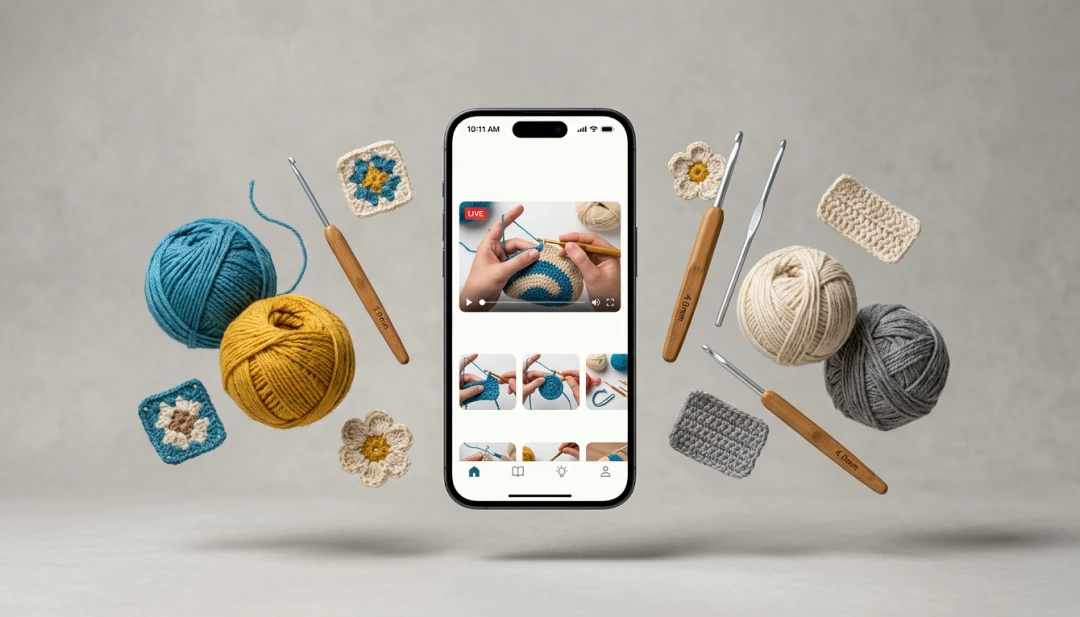
The content platform Nugatx offers a great example of this structured approach when presenting crochet courses by mobile. The difference is that the content does not try to cover everything at once, dividing the learning into thematic modules where each class focuses on a specific goal. Users of the platform report that this methodology results in a higher rate of completion of courses and in final projects of better quality, compared with attempts to learn through random videos on YouTube or social networking applications.
Another measurable benefit is the reduction of material waste. When you learn correctly from the beginning, you do not need to undo your work constantly because you have identified errors and now you can correct them during the process. This saves line, needles and, especially, rework time. Users who started with common mistakes often need to undo work days to correct structural failures, while those who started right advance without interruptions.
Techniques to Follow Tutorials on Mobile
A very effective strategy is to watch the full tutorial a first time just observing, without trying to reproduce. This gives you the overview of how the dot works and reduces the pressure to follow in real time. In the second visualization, start practicing following the rhythm of the tutorial, pausing when necessary. This double visualization transforms the experience because your brain already has a mental map of what will come next.
When you are working while watching a tutorial, tilt your phone at an angle that allows you to see both the screen and your work without completely turning to one side. There are simple and inexpensive supports specifically for this, or you can use a book to support the mobile. This small change dramatically increases your confidence because you can compare your work with that of the tutorial in real time, validating if you are doing it right.
Use also the slow motion or speed reduction function that many video applications offer. This is especially useful when learning complex points, because you can see exactly where the needle goes, how the line moves and what is the correct sequence of movements. Placing a video at 75% of normal speed may seem slow, but in practice saves hours of confusing practice because you understand better from the first time.
Avoiding Premature Withdrawal
Many beginners give up when facing their first real difficulties, usually in the first or second week of practice. This critical moment happens when the fingers are not yet coordinated, the line often curls on the needle, and the work becomes uneven. Most people do not realize that this is completely normal and is part of the learning curve of any manual skill. Understanding that this is a temporary stage you maintain motivation and persevere.
To avoid giving up, celebrate small victories.When you manage to make your first perfect low, your first midpoint or your first full row, recognize this as a real breakthrough.Take a photo, send to a friend, share with yourself. These small validations accumulate and strengthen your conviction that you are capable. Psychologically, our brain responds very well to frequent, even small rewards.
Consider also connecting with a community of people learning crochet, even if it is just online. Listening to stories of others who started zero and now produce amazing work is deeply motivating.Many online communities offer support, share tips and show projects in progress, creating an environment where quitting is less likely because you feel part of a group with common goals.
Conclusion
Starting to learn crochet on your phone is a great way to explore this art, but like any learning, it requires a structured and conscious approach to the common mistakes that walk the path of almost every beginner. When you choose suitable material, practice consistently for short periods, focus on one point at a time and keep your motivation high, practical results appear much faster than you expect. The difference between someone who learns in weeks versus months is usually not in talent, but in the quality of the methodology and the willingness to avoid known pitfalls. Start today, keeping these guidelines in mind, and soon you will be creating pieces that will make you proud of your progress.